
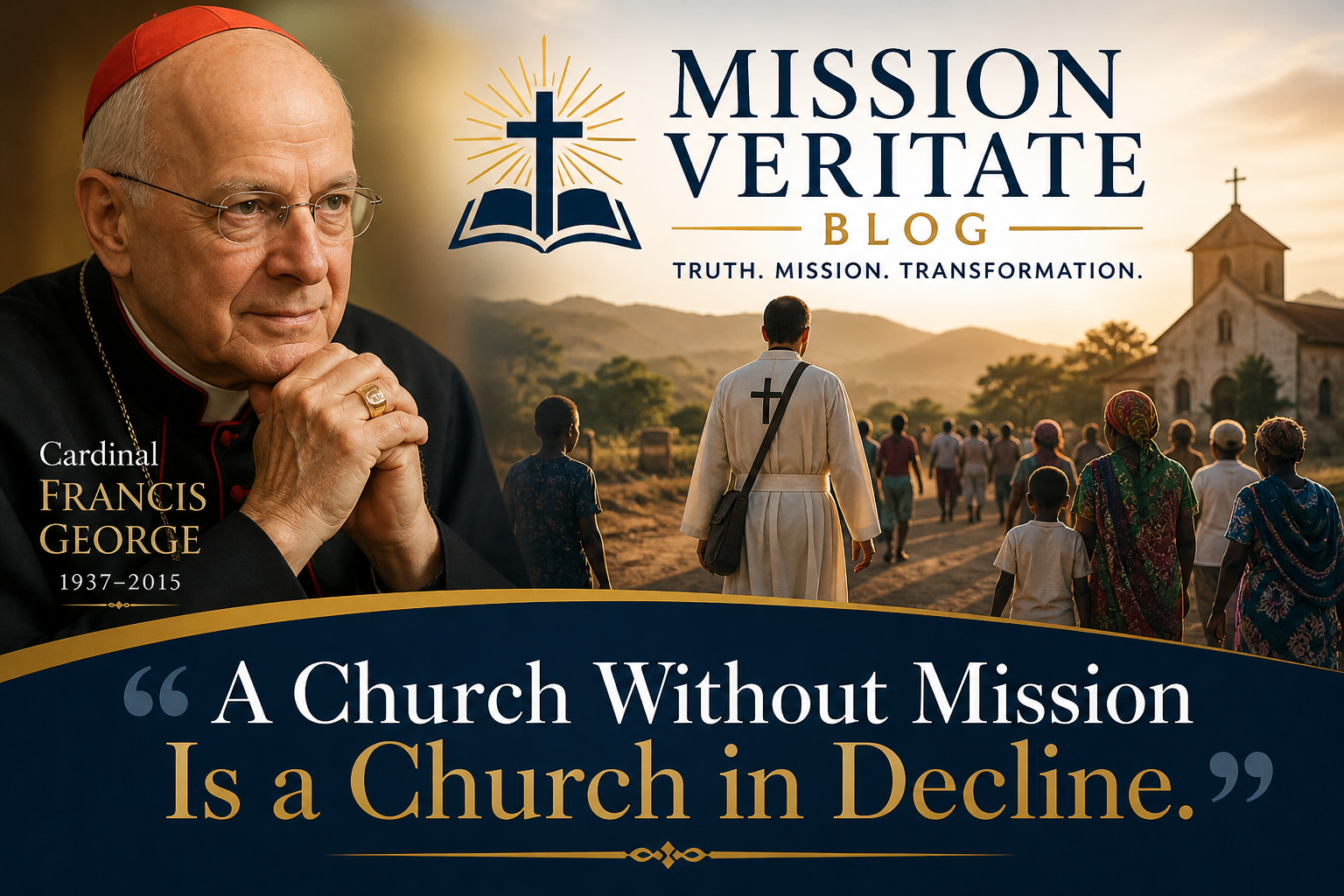
A Church Without Mission Is a Church in Decline
In the spirit of Francis George
The Church does not lose her life all at once. Decline begins quietly—when the urgency to proclaim Christ gives way to the comfort of maintaining what already exists. Programs continue, structures remain, but something essential fades: the sense that we are sent.
Cardinal Francis George spoke with clarity about this reality. Rooted in the teaching of the Second Vatican Council—especially Ad Gentes—he insisted that mission is not an activity among many. It is the very identity of the Church.
“The Church exists to evangelize.” This conviction, drawn from the heart of Catholic tradition, shaped his understanding of renewal. Where evangelization is strong, the Church is alive. Where it weakens, decline inevitably follows.
Mission Is Not Optional
For Cardinal George, the loss of missionary activity is not merely a strategic failure—it is a theological one. If the Church is missionary by nature, then to neglect mission is to misunderstand who she is.
Every baptized person is sent. Not only priests, not only religious, and not only those in foreign lands. The lay faithful, in their families, professions, and communities, carry the Gospel into places no institution can reach.
When this awareness disappears, the Church becomes inward-looking. Energy shifts toward preservation rather than proclamation. The result is not stability, but slow erosion.
The Drift Into Maintenance
One of the clearest signs of decline is what might be called “maintenance mode.” Parishes function, ministries operate, but the focus turns inward—toward budgets, structures, and internal concerns.
Cardinal George warned that this shift reflects something deeper: a loss of confidence in the Gospel itself.
“The first way we evangelize is by living lives that make no sense unless God exists.”
If this witness is absent, no program can replace it. A Church that no longer surprises the world with holiness will gradually be ignored by it.
Mission in a Secular Age
Cardinal George understood that the missionary frontier had shifted. In many parts of the world, especially the West, the challenge is no longer first evangelization, but re-evangelization.
“We are sent to a culture that no longer remembers the Gospel.”
This loss of memory creates a new urgency. Mission is no longer distant—it is immediate. It is found in neighborhoods, workplaces, and even within families.
This vision was later echoed by Pope Benedict XVI and Pope Francis in their call for a New Evangelization: a renewed proclamation of Christ in cultures that have grown indifferent to Him.
The Cost of Fidelity
Cardinal George did not present mission as easy or comfortable. He spoke with sobriety about the cost of remaining faithful in a changing world.
“I expect to die in bed, my successor will die in prison, and his successor will die a martyr in the public square.”
This striking statement was not meant to alarm, but to prepare. A Church that truly proclaims Christ will inevitably encounter resistance. If mission disappears, it may not be because the world has become more open—but because the Church has become more cautious.
Mission requires courage. It requires a willingness to stand apart, to speak clearly, and to accept misunderstanding or even rejection.
Renewal Begins With Going Out
If the absence of mission signals decline, then its recovery is the path to renewal.
This renewal does not begin with complex strategies. It begins with clarity:
confidence in the truth of the Gospel
formation of disciples who live visibly different lives
a willingness to go beyond comfort into real encounter
The local Church—parishes, families, and communities—must rediscover that they are not endpoints, but launching points.
Where this happens, something changes. Faith becomes contagious. Hope becomes credible. The Church grows—not only in numbers, but in depth.
Conclusion
A Church without mission does not remain neutral—she declines. Slowly at first, then more visibly, as her purpose becomes obscured.
Cardinal Francis George’s vision cuts through the confusion: to be the Church is to be sent. When that identity is embraced, renewal follows. When it is forgotten, decline is inevitable.
The choice is not between comfort and difficulty. It is between life and diminishment.
The Church lives when she goes forth.